Manuel V. Sulleiro
I am a chemist working on the surface chemistry of two-dimensional materials and on materials built from designed peptides.
CICA, Universidade da Coruña
Research interests
-
Chemistry on 2D materials
I like making chemistry work on surfaces that would rather not react. Much of my work has been on the covalent functionalisation of graphene, carbon nanotubes and MoS2, trying to add new functions without losing the properties that make these materials worth using.
-
Heterostructures and devices
Different 2D materials stacked together can do things neither does alone. I am interested in holding those stacks together through chemistry, and in what that means once they become part of electronic or sensing devices.
-
Peptides as building blocks
Designed peptides fold and pair in predictable ways. I use them to build fibres and three-dimensional scaffolds for biological applications.
-
Luminescent nanocarbons and sensing
Carbon dots and graphene quantum dots, where their emission comes from and how to put it to work in bioimaging. 2D materials also show up here, as platforms for electrochemical biosensors.
Selected work
-
Nature Chemistry
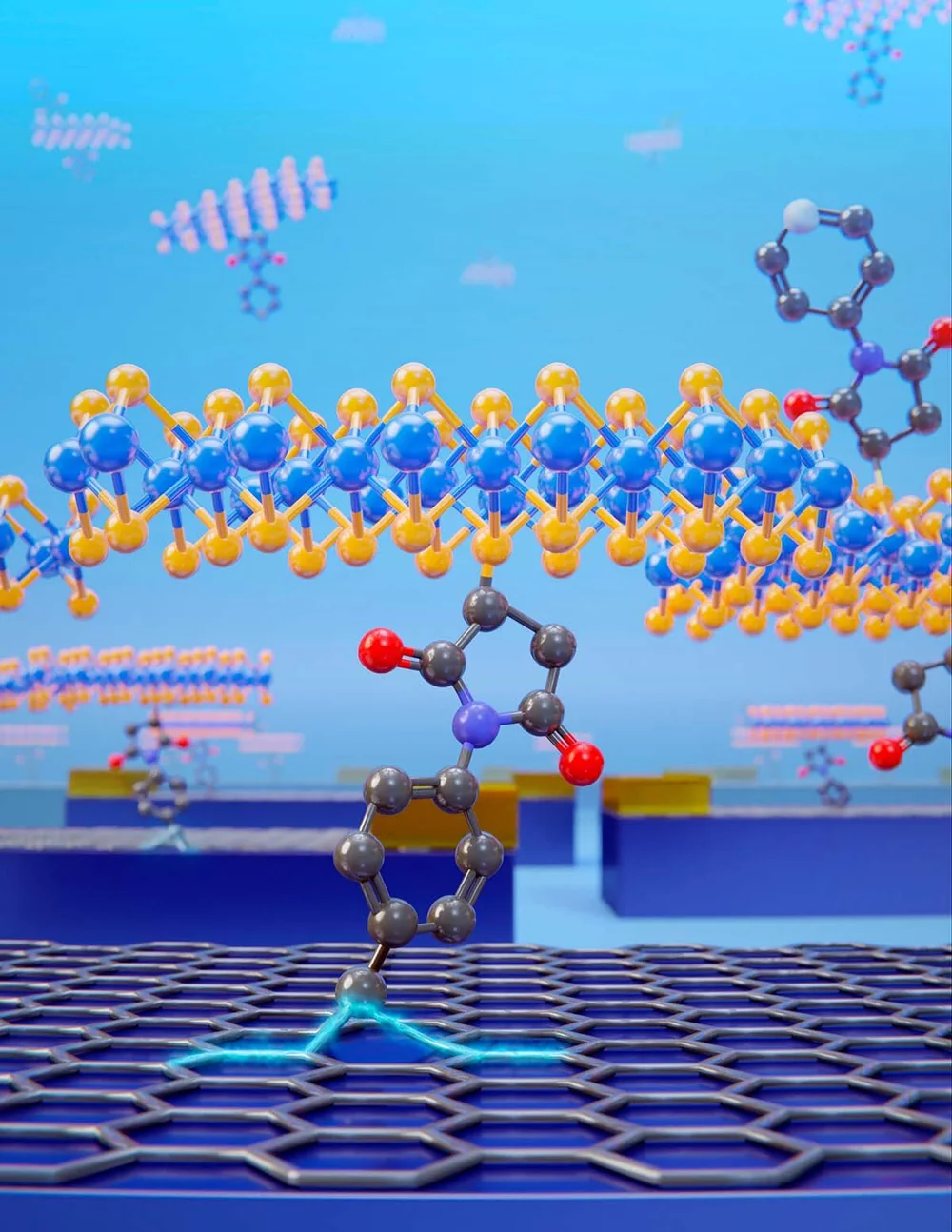
Fabrication of devices featuring covalently linked MoS2–graphene heterostructuresWe stitched two different 2D materials, MoS2 and graphene, together through a single molecule and built the junction straight into transistors. The molecule turned out to set how the two layers talk to each other, which makes the interface something chemistry can design.
Illustration: Patricia Bondía
-
Chemical Communications
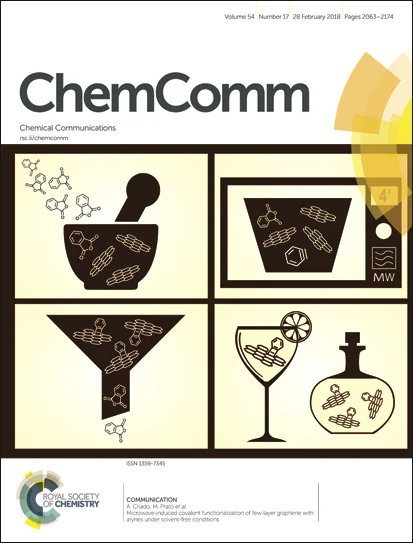
Microwave-induced covalent functionalization of few-layer graphene with arynes under solvent-free conditionsAn unconventional way to do chemistry on graphene. Graphene soaks up microwaves and heats itself in seconds, so it drives its own reaction with arynes with no solvent at all. It made the front cover of the issue.
-
Sensing and Bio-Sensing Research
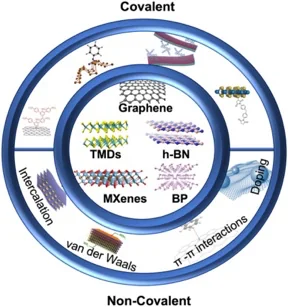
2D materials towards sensing technology: from fundamentals to applicationsOur view of where 2D materials stand in sensing, from how each material turns a chemical event into a signal to the devices that put it to use.
Path
-
Santiago de Compostela
Degree and master's in chemistry at the Universidade de Santiago de Compostela, with a first taste of organic synthesis at CIQUS and research stays in Kraków and Manchester.
-
Trieste
PhD with Maurizio Prato on new routes to the covalent modification of graphene and carbon nanotubes, including a stay at CIC biomaGUNE. The thesis received the university's best thesis award in physical sciences and engineering.
-
Gwangju
Graphene devices at the Gwangju Institute of Science and Technology, South Korea.
-
Madrid
Postdoctoral researcher at IMDEA Nanociencia with Emilio M. Pérez, working on the chemistry of low-dimensional materials.
-
Braga
International Iberian Nanotechnology Laboratory, with Pedro Alpuim, on graphene devices for biosensing.
-
A Coruña
CICA, Universidade da Coruña, in Elena Pazos's QUIMBIO group, working on peptide-based materials.
Contact
- ORCID
- 0000-0002-9688-7771
- Address
- CICA, Universidade da Coruña
Campus de Elviña
A Coruña, Spain - Google Scholar
- Profile
- Group
- QUIMBIO
Students looking for a final-year, master's or doctoral project are welcome to write to me.