Selected publications
A selection of peer-reviewed articles, grouped by topic. Each title links to the published version, and the complete list is on Google Scholar and ORCID.
-
Covalent chemistry of 2D materials
-
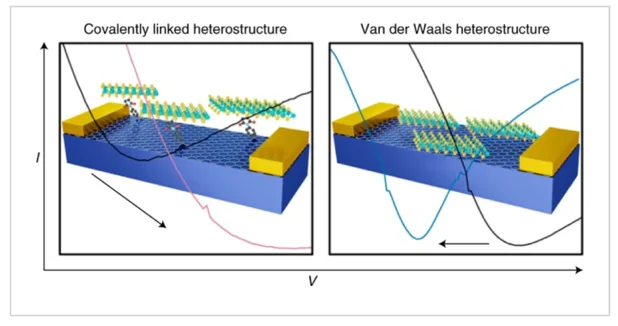 Fabrication of devices featuring covalently linked MoS2–graphene heterostructures
A bifunctional linker joins MoS2 and graphene directly on graphene transistors. I led the exfoliation and covalent modification of MoS2 and the spectroscopic proof of the covalent junction.
Nature Chemistry 14, 695–700
-
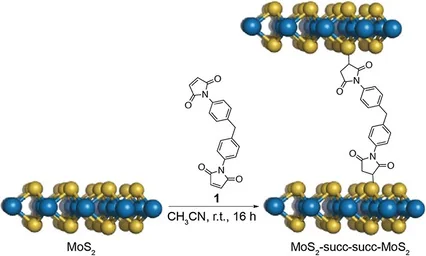 Covalent cross-linking of 2H-MoS2 nanosheets
A bismaleimide linker bridges two MoS2 flakes into vertical assemblies with a defined spacing. I designed the chemistry, from exfoliation to cross-linking and validation. Selected as a Hot Paper.
Chemistry – A European Journal 27, 2993–2996
- Controlled covalent functionalization of 2H-MoS2 with molecular or polymeric adlayers Equal first author. A mild maleimide protocol for semiconducting MoS2, tunable from molecular layers to polymer shells. I defined the reaction conditions and brought surface characterisation (Raman, XPS, AFM) to the group. Selected as a Hot Paper. Chemistry – A European Journal 26, 6629–6634
- Clicking beyond suspensions: understanding thiol–ene chemistry on solid-supported MoS2 Moves covalent chemistry on MoS2 from dispersions to flakes lying on a surface, which is where devices are made. Nanoscale 16, 3749
- Direct magnetic evidence, functionalization, and low-temperature magneto-electron transport in liquid-phase exfoliated FePS3 Extends covalent chemistry to magnetic van der Waals materials. I designed and validated the thiol–maleimide functionalisation while preserving the magnetic properties of the flakes. ACS Nano 17, 3007–3018
-
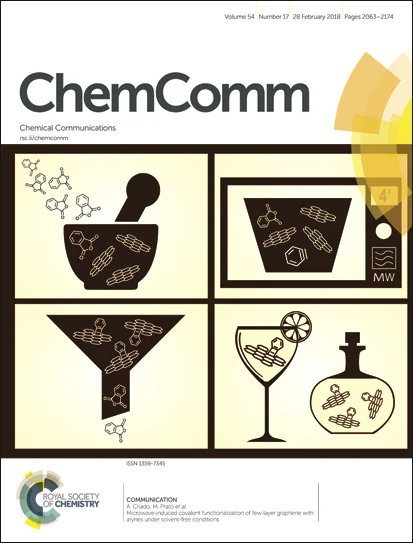 Microwave-induced covalent functionalization of few-layer graphene with arynes under solvent-free conditions
From my PhD. A solvent-free microwave route in which graphene acts as both reagent and microwave absorber. I brought aryne chemistry from CIQUS to the Prato group. Front cover of the issue.
Chemical Communications 54, 2086
-
-
Sensing
- Pathogen sensing device based on 2D MoS2/graphene heterostructure With Encarnación Lorenzo (UAM). I designed and synthesised the covalent graphene–MoS2 component, assembled by electrografting on screen-printed electrodes for pathogen detection. Sensors and Actuators B: Chemical 392, 134105
-
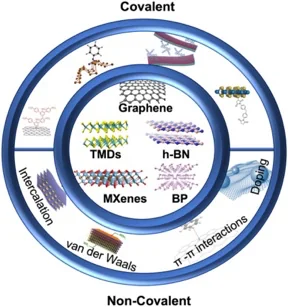 2D materials towards sensing technology: from fundamentals to applications
Our view of how 2D materials are used in sensing, from the basic principles to working devices.
Sensing and Bio-Sensing Research 38, 100540
-
Luminescent nanocarbons
-
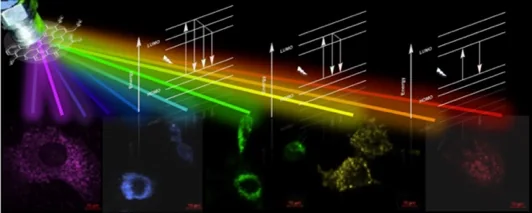 Exploring the emission pathways in nitrogen-doped graphene quantum dots for bioimaging
I led the photophysical and mechanistic study that traces where the emission of nitrogen-doped graphene quantum dots comes from. The start of an independent collaboration with CEITEC.
The Journal of Physical Chemistry C 125, 21044–21054
- Spontaneous formation of carbon dots helps to distinguish molecular fluorophores species Shows that emission usually attributed to carbon dots can come from aggregates of small molecular fluorophores. I coordinated and carried out the fluorescence and NMR characterisation. Applied Surface Science 610, 155536
-